

When to Start Solids in Australia: The Complete Guide for Parents


Wondering when to start solids with your baby? You're in the right place. Starting solids is one of the biggest milestones in your baby's first year — and one of the most common sources of confusion for Australian parents. When is the right time? What do the official guidelines say? And what are the signs your baby is actually ready?
This guide covers everything you need to know, based on the latest Australian health guidelines, so you can start solids with confidence.
What Do Australian Health Guidelines Say About Starting Solids?
The Australian National Health and Medical Research Council (NHMRC) recommends:
- Around 6 months is the ideal time to start introducing solid foods
- Not before 4 months — before this, babies' digestive systems are not mature enough
- Breast milk or infant formula should remain the main source of nutrition for the first 12 months
- Solids complement milk feeds — they don't replace them at this stage
Why Not Before 4 Months?
Starting solids too early carries real risks:
- Digestive immaturity: Babies lack the enzymes needed to digest solid foods before 4 months
- Choking risk: The tongue-thrust reflex is still very strong before 4–6 months
- Increased illness risk: Early introduction is associated with higher rates of respiratory infections and eczema
- Reduced milk intake: Solids can displace nutrient-dense milk calories babies need for brain development

Signs Your Baby Is Ready for Solids
Watch for developmental readiness — your baby should show most or all of the following:
Physical readiness signs
- Can sit upright with minimal support and hold their head steady
- Has lost the tongue-thrust reflex — doesn't push a spoon back out automatically
- Shows interest in food — watching you eat, reaching toward food, opening their mouth
- Can pick up objects and bring them to their mouth
Signs that do NOT mean readiness
- Waking more at night — normal infant behaviour, rarely related to hunger
- Seeming hungrier than usual — growth spurts cause temporary increases in milk demand
- Chewing fists — normal oral exploration, not a hunger signal
What Age Do Most Australian Babies Start Solids?
Most Australian babies begin solids between 5 and 7 months of age. If your baby was born premature, talk to your paediatrician — timing may be adjusted based on corrected age.
What Foods to Start With
Australian guidelines now recommend that first foods should be iron-rich, as babies' iron stores begin to deplete around 6 months.
Best first foods
- Iron-fortified infant cereal — mixed with breast milk or formula
- Pureed meat and poultry — beef, chicken, lamb
- Mashed legumes — lentils, chickpeas, tofu
- Pureed vegetables — sweet potato, pumpkin, peas, broccoli
- Pureed fruit — apple, pear, banana, avocado
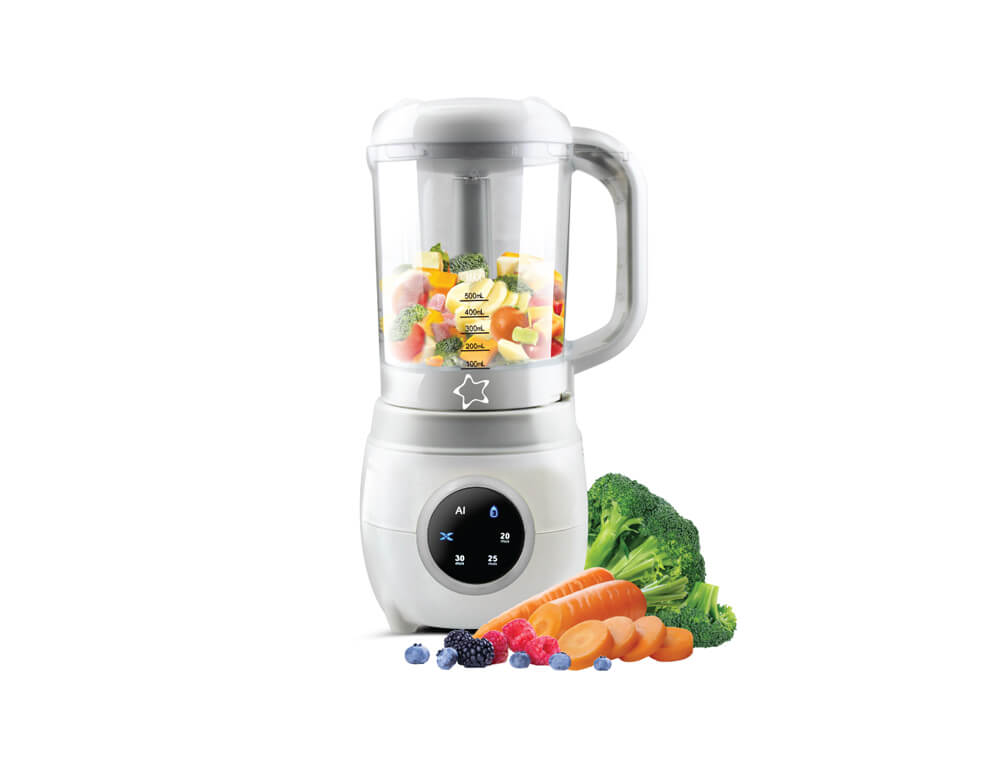
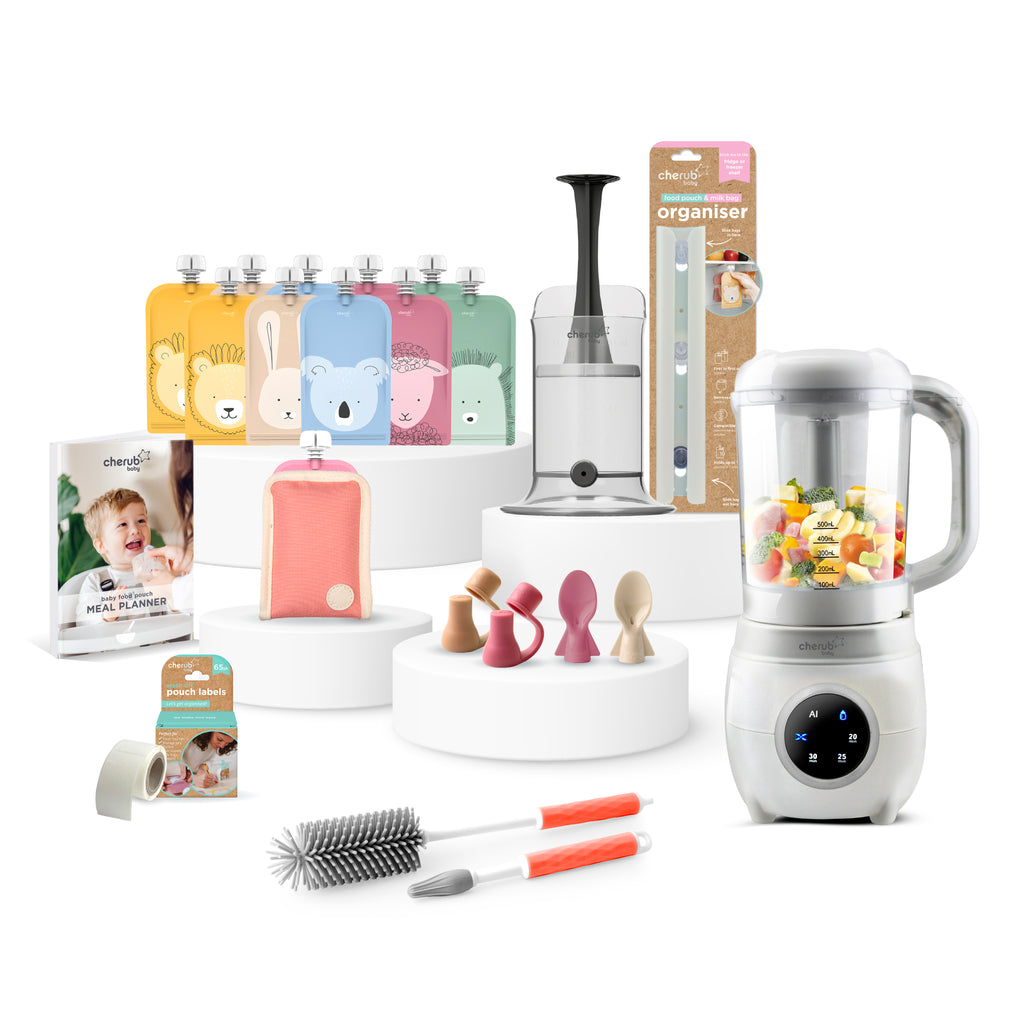
When your baby is ready to start their food journey, having the right tools makes all the difference. A baby food maker and steamer like the Cherub Baby Automatic Food Maker lets you steam and blend in one button — perfect for creating smooth first purees through to textured meals as bub grows. For on-the-go feeding, reusable food pouches let you fill with homemade food, freeze, and serve — far better than store-bought pouches for knowing exactly what goes into every meal.
Introduce common allergens early
Current evidence says to introduce common allergens early and often — peanut products, egg, tree nut butters, fish, wheat, dairy, soy, and sesame. Introduce one new food every 2–3 days and watch for reactions.
How Much Should a Baby Eat When Starting Solids?
- Start with 1–2 teaspoons once per day
- Gradually increase to 2–3 times per day over the following weeks
- By 7–8 months, move toward 3 small meals per day
- By 9–12 months, work toward 3 meals and 2 snacks alongside regular milk feeds
Never force feed. If your baby turns away or closes their mouth, stop.
Purees or Baby-Led Weaning?
Both are valid and safe. Purees allow careful texture progression. Baby-led weaning (BLW) with soft finger foods develops motor skills and may reduce fussy eating. Many Australian families combine both. Choose what works for you and your baby.
Practical Tips for Starting Solids
- Pick a good time — offer solids when your baby is happy and alert, not overtired
- Make it social — eat together as a family; babies learn by watching
- Embrace the mess — mess is normal and important for learning
- Introduce water — offer small sips of cooled boiled water in a sippy cup from 6 months
- No added salt or sugar — babies' kidneys can't handle excess sodium
As your baby begins solids, you may find it helpful to ease the transition from milk by introducing our Fresh Food Feeder, designed to let little ones safely explore new tastes and textures at their own pace.


Frequently Asked Questions
When should I start solids in Australia?
Australian health guidelines recommend starting solids at around 6 months, but not before 4 months. Most babies show readiness signs between 5–7 months. Watch for developmental signs like sitting with support, head control, and loss of the tongue-thrust reflex.
Can I start solids at 4 months in Australia?
The guidelines say not before 4 months as an absolute minimum, with 6 months being the recommended target. Talk to your child health nurse if you're considering starting before 6 months.
What is the first food I should give my baby?
Start with iron-rich foods — iron-fortified infant cereal, pureed meat, chicken or lentils — because babies' iron stores deplete around 6 months. After those are established, introduce a wide variety of vegetables, fruits, and other textures.
Should I give purees or finger foods first?
Either approach is safe and supported by Australian health authorities. Many families combine both. Choose what suits you and your baby — there's no single right answer.
How do I know if my baby is ready for solids?
Look for: sitting upright with support, steady head control, loss of the tongue-thrust reflex, showing interest in your food, and ability to bring objects to their mouth. Age (around 6 months) plus these developmental signs together indicate readiness.
Based on current Australian NHMRC guidelines. Always consult your maternal child health nurse or GP for personalised advice, especially if your baby was born prematurely or has a history of health issues.
Related Reading
- Baby Finger Foods: 15 Best Ideas for 6 Months+ — safe first finger foods once your baby is ready to start solids
- Breast Milk Storage Guidelines Australia 2026 — how long breast milk lasts and safe storage tips
- Baby-Led Weaning vs Purees: Which Is Right for Your Baby? — compare your options for starting solids
- Iron-Rich First Foods for Babies Australia — the best haem and plant-based iron sources to prioritise from six months
- How to Introduce Allergens to Your Baby in Australia — 2026 ASCIA guide to safe, early allergen introduction
- Baby Food Puree Recipes for 6 to 12 Months — easy stage 1 and stage 2 puree ideas backed by NHMRC guidelines
- Baby Meal Plan for 6 Months: Week-by-Week Guide — a practical week-by-week feeding plan for the first month of solids


