

Are Reusable Food Pouches Worth It? An Honest Cost and Time Breakdown


For most Australian families, yes — reusable food pouches pay for themselves within about six to eight weeks. A set of reusable pouches costs roughly the same as two or three weeks of shop-bought pouches, and after that every serve you fill costs you cents rather than dollars. The trade-off is real, though: you have to actually wash them, and you have to actually make the food.
That's the honest version. Here's the maths, the time cost, and the situations where they genuinely aren't the right call — and if you'd like a straight side-by-side, see our full comparison of reusable vs disposable baby food pouches.
The cost, honestly
Shop-bought pouches in Australian supermarkets typically land somewhere between $1.80 and $3.00 each, with organic ranges at the top end. A baby eating one or two pouches a day is an ongoing cost of roughly $50–$120 a month — and that's before toddlerhood, when pouches often become a snack rather than a meal.
A set of reusable pouches is a one-off spend. Fill them with homemade puree and the cost per serve is essentially the cost of the vegetables: a couple of sweet potatoes, a bag of frozen peas, an apple. Realistically you're looking at 20–50 cents a serve, and a lot of that is food you already have in the house.
Where the maths breaks even
Take a baby eating one pouch a day:
- Shop-bought: ~$2.20 × 30 days = ~$66 a month
- Reusable: one-off pouch set + ~$0.35 × 30 = ~$10 a month in food
The set typically pays for itself somewhere in month two, and every month after that is savings. Over a year of pouch-feeding, the difference runs into hundreds of dollars — and considerably more if you have a second baby, because the pouches keep going.

The time cost — the part nobody mentions
This is where honesty matters. Reusable pouches do create work:
- Washing. A good reusable pouch is dishwasher-safe and opens wide enough to clean properly by hand. A badly designed one is a nightmare. This single feature is the difference between a system you keep using and a drawer full of guilt.
- Batch cooking. Realistically, one hour on a Sunday will fill a week's worth. It is not a daily job — but it is a job.
- Freezer space. Filled pouches freeze flat, but you need somewhere to put them.
If that hour is one you simply don't have right now — new baby, no help, back at work — that's a completely legitimate reason to keep buying shop-bought pouches, and nobody should make you feel bad about it.
What actually makes it easy
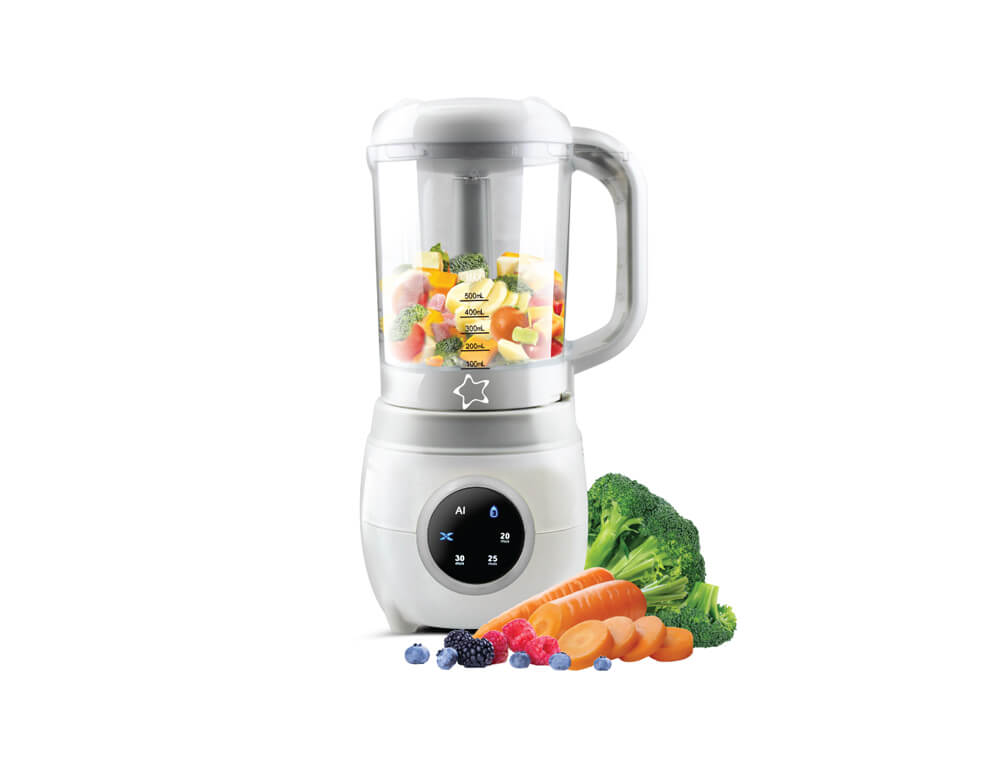
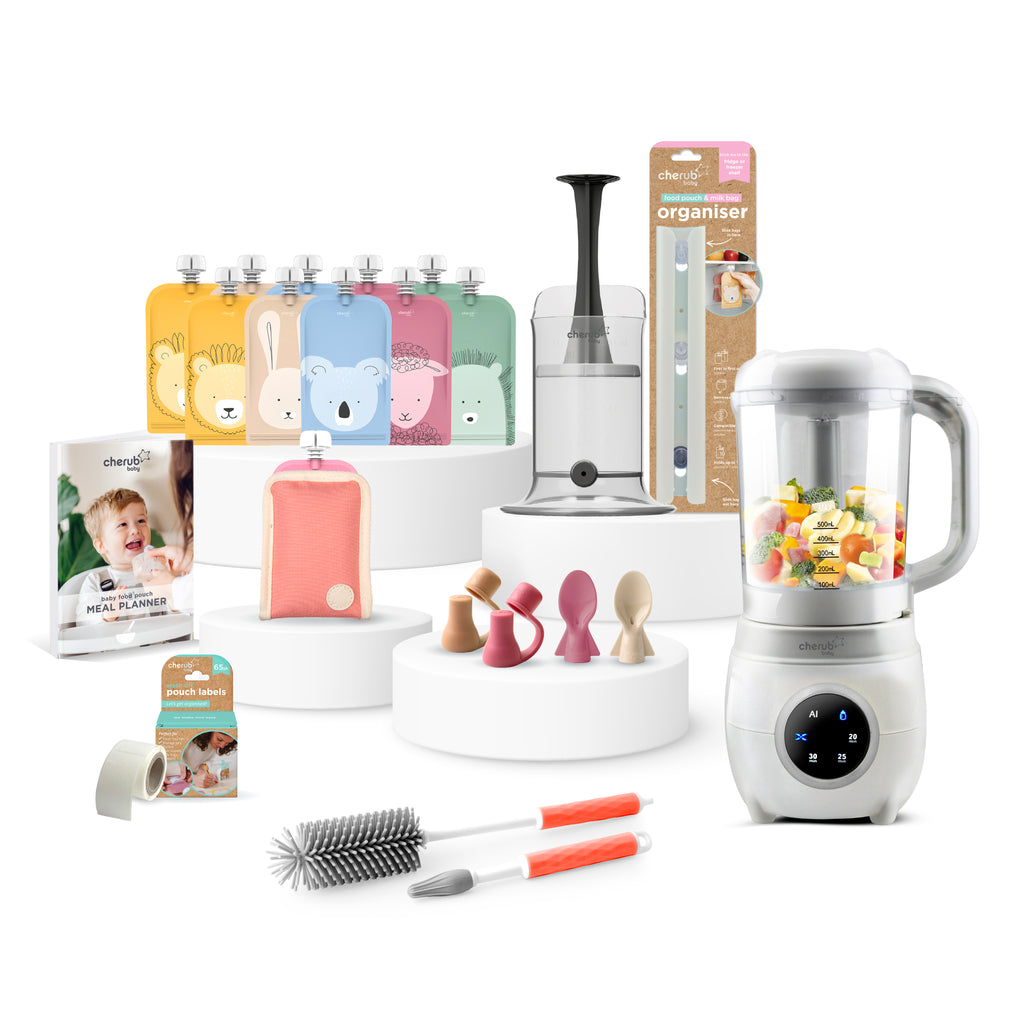
The families who stick with reusable pouches almost always have two things: a way to cook and puree in one go, and a way to fill the pouches without wearing the puree. An all-in-one baby food maker steams and blends in one bowl, which turns "cook a batch of baby food" from a three-pot job into a fifteen-minute one. Our simple puree recipes are built around exactly that.
The reasons that aren't about money
You know exactly what's in it
You control the ingredients completely — no added fruit juice concentrate quietly sweetening a vegetable puree, no unfamiliar names on a label. That matters more than parents expect once solids get going.
Texture progression
Shop-bought pouches are smooth by design and stay smooth. Babies need to move on to lumps and then to real textures, and Raising Children Network is clear that texture progression matters for chewing and speech development. With a reusable pouch you decide how coarse the puree is — and when to stop using pouches altogether.
The waste
One baby, one pouch a day, one year: that's around 365 foil-and-plastic pouches that can't go in kerbside recycling. It's a small thing that adds up in a way that bothers a lot of parents once they notice it.
When reusable pouches are NOT worth it
Being straight with you:
- If you're only using pouches occasionally — the odd one in the nappy bag — the savings never really arrive.
- If your baby has moved to finger foods and family meals and pouches were never really part of the picture, skip them entirely.
- If the washing-up is the thing that will break you right now. This is a real and valid answer. Come back to it in a few months.
- If you buy cheap, poorly designed pouches that don't open properly to clean. You'll use them twice and resent them.
What to look for if you do buy them
- A wide opening that turns inside out or opens fully, so you can see and reach every surface.
- Dishwasher-safe — top rack, no exceptions.
- Freezer-safe, so you can batch and store.
- BPA, lead and PVC free — non-negotiable for anything holding your baby's food.
- Soft, replaceable spouts, especially once teeth arrive.
- A fill station if you're doing more than a couple at a time. It is the difference between a calm Sunday and puree on the ceiling.
Our reusable food pouch range is built around exactly those requirements — wide-opening, dishwasher and freezer safe, and BPA, lead and PVC free. Shop the range →


Frequently asked questions
How long do reusable food pouches last?
A well-made pouch, washed properly, will comfortably last through a baby and into toddlerhood — and often through a second child. Spouts wear out before the pouches do, which is why replaceable spouts matter.
Are reusable pouches hygienic?
Yes, provided you can clean them properly. That means a pouch that opens wide enough to reach every corner, washed promptly after use — not left in the car for two days. Dishwasher-safe pouches make this far easier to keep up with.
Can you freeze reusable food pouches?
Yes. Freezing filled pouches is what makes the whole system work: batch-cook once, freeze flat, then take one out the night before. Leave a little headspace, because puree expands as it freezes.
How much money do reusable pouches actually save?
For a baby eating one pouch a day, roughly $50–$60 a month once the initial set is paid off — several hundred dollars across a year of pouch-feeding.
Do reusable pouches leak?
A good one doesn't. Leaks are almost always down to a poorly seated spout or overfilling. Fill to the line, screw the spout on straight, and check the seal before it goes into the nappy bag.
What age can babies use food pouches?
From around six months, when solids begin. Early on, feed from a spoon rather than letting your baby suck straight from the pouch — spoon feeding gives them a proper sense of the food and its texture.


